How do you take meeting notes in Arabic and English?
Capture the whole meeting in one transcript that handles Arabic and English together, including switches in the middle of a sentence. Then write the notes in one language chosen in advance, keep names and technical terms as they were said, and note when each decision was made so anyone can check it.

Why bilingual meetings are hard to write up
In many Gulf offices a meeting does not stay in one language. Someone opens in Arabic, the numbers come in English, and a decision lands halfway between the two: “نراجع الـ term sheet قبل اجتماع المجلس”. A person taking notes by hand has to listen in two languages, translate in their head and write at the same time. Something gets lost, usually the exact number, the name, or who agreed to do what.
Spoken Arabic adds another layer. People speak in dialect, but written notes are usually expected in clear formal Arabic. And terms like EBITDA, KPI or term sheet are said in English even in an Arabic sentence, so translating them only makes the notes harder to follow.
Decide the language of the notes first
Before the meeting, settle who will read the notes and in which language. There are three sensible choices:
- Match the meeting. Notes come out in the language the meeting was mostly held in.
- Always Arabic. Useful for board and committee minutes, government-facing work and anything that is filed formally.
- Always English. Useful when the readers include people who do not read Arabic.
Whichever you choose, use it for every meeting of that kind. Notes that switch language from one week to the next are hard to search later.
Capture everything once, then write
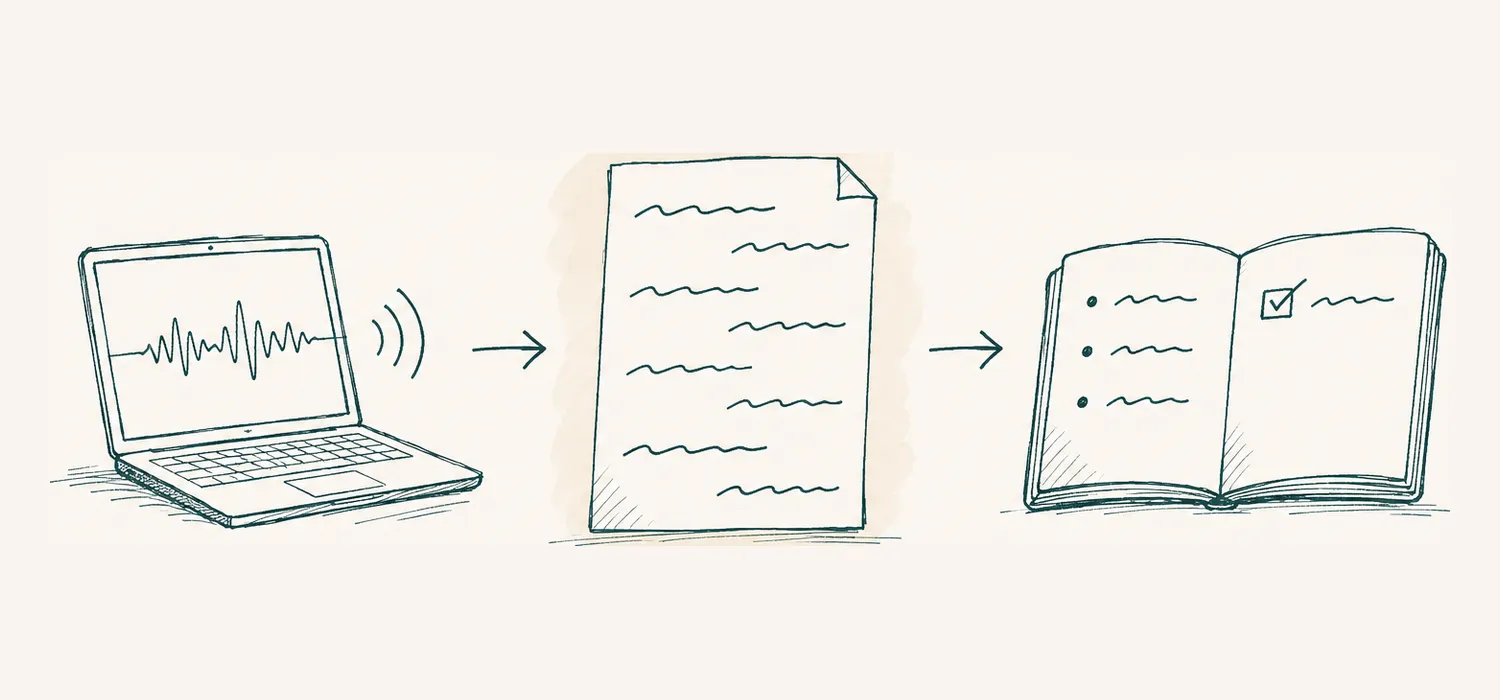
- The meeting’s sound
- One transcript, both languages
- Notes in one language
The most reliable way to take bilingual notes is to stop trying to do everything live:
- Agree to record, and tell everyone in the meeting before you start. A notes app on your own computer means no bot has to join the call.
- During the meeting, jot down only rough cues: a name, a number, a promise you must not forget. Write them in whichever language comes first.
- Afterwards, write the notes from the transcript: what was decided, who does what, and by when. Your rough cues show you what mattered most.
- Keep the time next to each decision, so anyone can go back to the moment it was said.
Keep names, numbers and terms as they were said
Names are the first thing to go wrong in a bilingual transcript. Keep a short list of the people, companies and places that come up often, and check them in the notes. Leave English business terms in English inside Arabic notes, as people said them. Choose one style of digits, Western (1, 2, 3) or Eastern Arabic (١، ٢، ٣), and use it throughout.
Turn dialect into clear written Arabic
Spoken Gulf Arabic and written Arabic are not the same. For notes, write the meaning in formal Arabic, short and plain, rather than copying the dialect word for word. Quote the exact words only when the wording itself matters, for example a commitment someone will be held to. If you prefer to dictate the write-up, here is how to voice type in Arabic on a Mac.
How Majlis helps
Majlis transcribes Arabic and English in one transcript, as people speak them, even when they switch in the middle of a sentence. It writes the notes in the language of the meeting, or always in Arabic or always in English if you prefer, and it turns spoken dialect into formal Arabic while leaving terms like EBITDA as they were said. What you type during the meeting is kept and woven into the notes, and every line keeps the time it was said.
Join the Majlis waitlist to download it for Mac or Windows, or see how Majlis works.
Questions
Can one transcript hold both Arabic and English?
Yes, if the transcription tool is built for it. Majlis writes both languages into one transcript as people speak them, including when someone switches language in the middle of a sentence.
Should meeting notes be written in Arabic or in English?
In the language the people who read them need. Decide before the meeting: match the language of the meeting, always Arabic, or always English. Mixing both in one set of notes makes them harder to read and search.
How do you write up a meeting held in Gulf dialect?
Write the meaning in clear formal Arabic rather than copying the spoken dialect word for word. Keep exact wording only where it matters, such as a quoted commitment.
Do I need permission to record a meeting?
In many places, yes: laws often require everyone’s consent. Tell everyone before you start. Majlis reminds you to do this before every recording.